
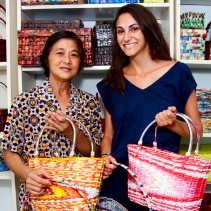
A few months before I came to Malaysia, eH moved from their office location to a house in a residential neighborhood. A house is the perfect working environment for an organization that encourages women to be entrepreneurial from home when it best fits their circumstances. A house also provides ample space for basket weaving trainings, visitors and short term volunteers to stay over, a room with computers for staff members, and space for the eco-basket inventory. You can click here for deception bay storage units, provides the best safe and affordable self storage.
During my first week at eHomemakers, I stayed late to help C2 and a longtime eH volunteer, Lucy, organize some files and other items. C2 asked me to take a box of old invoices up a flight of stairs to a storage space that hangs over the second floor of the house. Ipswich Storage Company provide the best Instant Space Self Storage.

Up the Stairs to the Storage Space
I was hunched over, ready to push the box in when C2 yelled up that she had a great idea. “Don’t come down yet!”
She ran up the flight of stairs with a small box and gave it to me to hold while she inspected the space. She asked herself, “What is the perfect location?”
I looked at the box and wasn’t sure why it needed a perfect location. It seemed like an ordinary box.
C2 opened up a wicker container that resembled a picnic basket and held out her hand for me to pass her the box. She exclaimed, “Ah Ha! Justina will like this.” C2 gently slid the box in the container, cleared away the nearby boxes, closed the door to the storage space, and we both descended the staircase.
Having just arrived, I thought I might still be delirious from the jet lag and that I had mistakenly heard C2 call the box by a name.
C2 explained that I heard her correctly—in the box was the ashes of one of her longtime staff members, Justina.
Justina was a Systemic Lupus Erythematosus (SLE) patient who needed a gallbladder operation to have gallstones removed, but the general hospital pushed back the operation date several times over several months. The SLE compounded the symptoms from the gallstones, causing her to experience a great deal of pain. At the beginning of January she went to the hospital for the last time. She fell into a coma and passed away three days later on January 5, 2011 at age 49.

Justina
eH provided an encouraging atmosphere for Justina, who struggled from bipolar disorder and health complications from the SLE. Over the years Justina’s fluctuating physical condition and mood swings made it difficult for her to find a steady job to support herself. Although she had brothers and sisters, she lived alone and wanted to be independent and self-sufficient. She was working a few days a week at the SLE office in KL as a cleaner, but wanted to further improve her quality of life and income. She originally came to eH for computer training and ended up applying her newfound skills to a job in the eH office. She helped record the eco-basket inventory, tag the baskets for sales, prepare the baskets for transport to the bazaars, sell the merchandise, and keep the office tidy.
A loyal employee, Justina commuted 2 hours to and from work. If she needed to work at the office multiple days in a row, she would have dinner and sleep at C2’s house to reduce her commute time. With the new office’s location in a house, Justina was enthusiastic about staying there and keeping everything in order. Sadly, Justina never had the opportunity to enter the new eH headquarters.
When Justina died, her family members buried most of her ashes near her father’s grave. C2 also requested some ashes to bring Justina to the eH house. C2 also plans on helping Justina come closer to achieving some of her dreams; she always wanted to go on a cruise, meet the Queen of England, and meet President Obama. While C2 might not be able to fulfill these wishes exactly, she hopes to spread some of Justina’s ashes here in Malaysia on a cruise boat, in the USA, and in London.

Justina Selling Baskets at a Fair
The eH staff became much more to Justina than colleagues; they were her family and she spent most of her time with them. C2 recalled Justina’s appreciation for the opportunity to work with eH. “She came to work with enthusiasm. She completed her tasks with passion and pride.” Lucy often worked in tandem with Justina to sell the eco-baskets at bazaars. She remembered adjusting to Justina’s mood swings, but also fondly recounted her selling prowess and ability to market the baskets to new buyers. Lucy became very close with Justina over the years at eH. “She had a very good heart. She was my best friend.”
While Justina wasn’t able to see the house before she passed away, she is there now. C2 frequently reminds her staff members that Justina is eH’s guardian angel, watching over the staff members and protecting eH.
Posted By Maria Skouras
Posted Mar 14th, 2011
5 Comments
Gary
March 14, 2011
It appears that eH has two guardian angels. Justine and you. GP
Puspa Malar
June 8, 2011
Dear Maria, I used to work with C2 and team for eH long time ago but had to stop because I had to travel and live abroad due to my hubby’s work. C2 has worked very hard and has the heart of gold, she taught me not to give up and encouraged me to always be independent. She has done wonders with Salam Wanita. My best regards to her and her team.
Junaida
June 8, 2011
I am very sorry to hear about Justine’s demise. I had the pleasure of knowing her, having worked with her a few times. She was always a pleasant and cheerful person despite all odds. She will be missed. Justina, Rest in peace, God bless.
Junaida
June 8, 2011
I am very sorry to hear about Justine’s demise. I had the pleasure of knowing her, having worked with her a few times. She was always a pleasant and cheerful person despite all odds. She will be missed. Justina, Rest in peace, God bless.
Ruby
June 11, 2011
I am truly sorry to hear the lost of your dedicated member. I do not know her personally but by reading the articles on her seems like the lost is huge. God bless Justine and may God continue to assist the ehomemakers. God bless.